By Thobile Jiwulane:
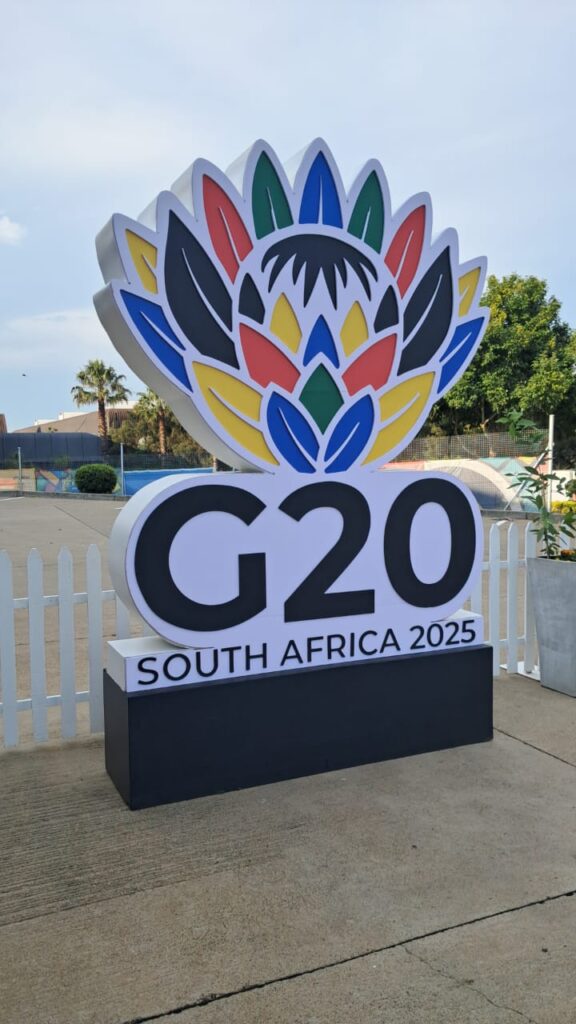
United Nations Secretary-General António Guterres says Africa must be given a permanent seat at the United Nations Security Council and be represented on the boards of the International Monetary Fund and the World Bank and other global bodies
Guterres, who was delivering opening remarks to the Media at the G20 Summit in Johannesburg, South Africa, on Friday, repeatedly expressed concern that Africa is not represented in these bodies and is inadequately represented in other global bodies.
To give Africa and others a voice
“Africa must have a fair seat in every forum where decisions are made – from the boards of international financial institutions to permanent seats in the United Nations Security Council, and to other global bodies,” Guterres said.
He pinned his hopes on the G20 as a forum that can help to repair “this historic injustice” and drive reforms that give developing countries, and Africa in particular, a real voice in shaping global policies, and make global economic governance more inclusive, representative, equitable and effective in the years ahead.
Call for new instruments to ease debt burden
“I will also urge G20 members to live up to the commitments made in June in the Financing for Development Conference in Sevilla to unlock more finance for developing countries.
“To triple the lending power of multilateral development banks, to increase their role in leveraging more private finance and to ease debt burdens with new instruments to reduce borrowing costs and risks, and speed up support for countries facing debt distress, drawing on recommendations from my debt expert group,” he said.
He promised to urge the G20 members attending the summit to help developing countries strengthen their capacity to mobilise domestic resources and to “build trade bridges, not trade barriers”. Too many developing countries – especially in Africa – find themselves at the bottom of value chains, or locked out of trade opportunities,” Guterres said.
UN is powerless to act to reform these bodies
When international institutions were created, most African countries were still under colonial rule, and their voices were absent from the table. “Today, Africa remains woefully under-represented across global institutions. This must change,” the UN chief said.
The Pact for the Future, adopted by Member States last year, called for a reform of global financial institutions. Many decisions are disproportionately in the hands of some of the members of the G20 across the governance bodies of these institutions. But the UN is powerless to reform the Security Council, World Bank and IMF and the countries that had the power to do that were reluctant to redistribute the power to other nations.
“Too many developing countries – especially in Africa – find themselves at the bottom of value chains, or locked out of trade opportunities. G20 members can lead the way by dismantling trade barriers and ensuring trade-free access to their markets for the poorest countries.”
Pat on the back for hosting South Africa
Guterres commended President Cyril Ramaphosa, as G20 President, for commissioning a bold report on global inequality and for putting on the G20 table “issues that mattered”.
On climate change, he said countries have failed to keep temperatures to the 1.5 °C temperature rise limit. Avoiding more climate chaos means bridging the adaptation gap – urgently and that requires a massive scale-up of financing for anti-climate change initiatives. There is a need to supercharge the just transition to renewable energy.
Last year, 90 per cent of new power capacity came from renewables and global investment in clean energy reached $2 trillion – $800 billion more than fossil fuels.
But there is very little benefit for Africa
“But only a negligible proportion went to Africa. Africa should be at the heart of this clean energy revolution. The continent holds immense solar and wind potential, but lacks the investments needed to harness them. A just energy transition must also mean to entirely electrify Africa – powering homes, schools, clinics and industries, and creating decent jobs for its young people.
“No one should be left in the dark by the clean energy age – least of all a continent that has contributed the least to the climate crisis. The economics are on our side, but political will needs to catch up,” Guterres said.
Fossil fuels still receive vast subsidies, and corporations are pocketing record profits from climate devastation. And lobbyists continue to greenwash the truth, while developing countries are locked out of a greener future. All countries can make a shift by aligning national policies and budgets with a just energy transition.
Technology is crucial to development
“It means providing resources and technology to help developing countries invest in grids, storage and efficiency. It means supporting workers and affected communities to make the transition, through training, protection and new opportunities and it means unlocking finance at scale for developing countries by cutting the cost of capital and crowding in private investment,” he said. The UN chief promised to discuss these issues in detail with G20 leaders on Saturday.
He called for action on peace in all areas hit by conflict, including Sudan, Ukraine, Gaza, Yemen and the Democratic Republic of the Congo, Haiti and Myanmar. – @NewsSA_Online
Please like, follow and engage with us on our social media platforms, links below: