BY DR FUMENE GEORGE TSIBANI:
By Dr Fumene George Tsibani, Water Governance and Heritage Expert at the University of Johannesburg, writing in his personal capacity
Two months before South Africans vote on 4 November 2026, surveys indicate that outcomes in the Eastern Cape remain far from settled. The most telling development is in four strategic municipalities where nomination failures have removed the ANC from the ballot.
This campaign coincides with Heritage Month. Heritage Month is defined by Intlokohlaza: the praise poem tradition associated with the honourable Professor J J R Jolobe. Intlokohlaza means Spring. In isiXhosa, September is EyoMsintsi: the month of the coast coral tree, when buds break. Jolobe does not present Spring as decoration; he presents Spring as labour, renewal, first fruits, clearing and planting after winter. Spring is not a metaphor for speeches; it is a metaphor for work.
The importance of Intlokohlaza lies in its demand for visible renewal, not rhetorical renewal. It is read as infrastructure: catchments cleared, furrows opened, storage prepared. September is an audit of winter. The audit asks what was left to rot; what pipes were left to leak; what nomination forms were left unsigned. If heritage is diverse, Spring is universal. Service delivery is Spring work.
Current support reflects a shifting pattern. Movements continue to enjoy regional strongholds that reflect history and identity. In this analysis, movements mean liberation movements. The lineage includes PAC of Azania, AZAPO and ANC. PAC of Azania and AZAPO lost significance in the post-1994 period; organisational depth narrowed and electoral presence thinned. It is now the ANC losing ground in Spring, in four municipalities that anchor future growth. The figures reflect support among registered voters who selected a movement on an electronic imitation ballot designed to simulate a secret vote and reduce social desirability bias.
The provincial picture of liberation movements is facing an uphill battle in many provinces, while movements continue to enjoy particularly strong support in their traditional heartlands where organisational depth remains. In the Eastern Cape, that heartland is now under pressure.
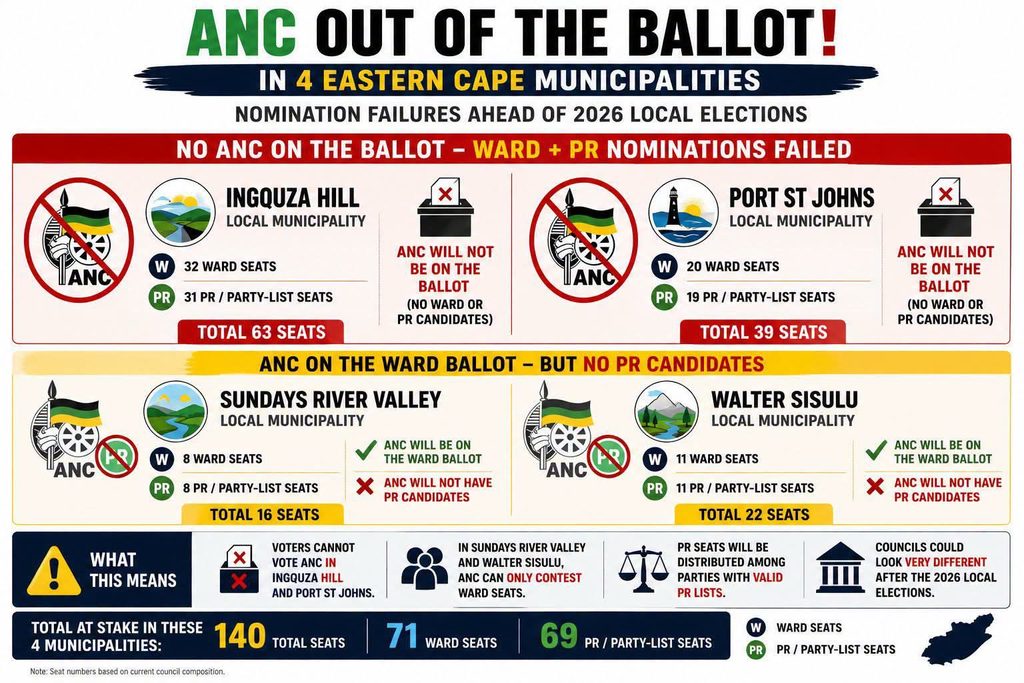
That pressure is visible where 140 seats are at stake: 71 ward and 69 PR seats. These are not peripheral zones; they are anchors to Eastern Cape development, linking marine, maritime and ocean economy, citrus agribusiness, and inland and coastal tourism.
Ingquza Hill accounts for 63 seats: 32 ward and 31 PR. There will be no ANC on the ballot at all. Its value is structural: the threshold of the N2 Wild Coast Road and the Mega Msikaba Bridge. This corridor will open the Wild Coast, drive logistics, demand bulk water and sanitation, and require heritage-sensitive planning. No ballot means no planting.

Port St Johns accounts for 39 seats: 20 wards and 19 PR. There will be no ANC on the ballot. Its value is maritime: tier one of small harbour development, identified for Smart City development within the Eastern Seaboard Development. This is fisheries, small harbour infrastructure, water security and coastal heritage tourism. Smart communities need smart service delivery models of the 21st century.
Sundays River Valley accounts for 16 seats: 8 wards and 8 PR. The ANC will be on the ward ballot but will have no PR candidates. Its value is economic: a current citrus GDP contributor, dependent on irrigation from the Gariep and Fish River systems and export logistics. The water, energy and food nexus is direct in this valley.
Walter Sisulu accounts for 22 seats: 11 ward and 11 PR. The ANC will be on the ward ballot but will have no PR candidates. Its value is geographic: the Gariep Dam tourism anchor, linking water storage to inland tourism and hospitality as a destination of choice.
The implication is direct: voters cannot vote ANC in Ingquza Hill and Port St Johns; in Sundays River Valley and Walter Sisulu, the ANC can only contest ward seats. PR seats will be distributed among parties with valid PR lists; councils could look very different after 2026.
Surveys indicate that after early November, most municipalities in this group will be run by coalition governments. Coalition is now South Africa’s new democratic Spring and new heritage: a synergism born of necessity and maturity with democracy.
In the language of Intlokohlaza, Spring is not given; it is made. It is made by clearing weeds of leadership arrogance; by negotiating sharing of sunlight and water; by planting together for a common harvest. If September is about renewal of land, November is about renewal of good enough governance. Renewal means accountability for taps, pipes and catchments. It means honouring diverse histories through dignity and delivery. The test will be whether this Spring is authentic: whether heritage is lived through clean water, working lights and paved roads, or whether it remains poetry without planting, as seen by JJR Jolobe and those before him.
Dr Fumene George Tsibani, Water Governance and Heritage Expert, Faculty of Engineering and the Built Environment, University of Johannesburg. He is writing in his personal capacity. – @NewsSA_Online
Follow us on our social media platforms below: