By Fumene George Tsibani:
- PURPOSE
This paper examines the continuum of Royal Monarchy resistance of AmaXhosa Omthonyama by linking two acts of remembrance: the launch of the Imbumba yamaNyama Congress in Ngqeberha on 10 May 1891 by Dr Mpilo Walter Benson Rubusana kaCirha, and the inauguration of President Rolihlahla Nelson Mandela on 10 May 1994. It interrogates how colonial and apartheid administrations distorted pre-colonial genealogies and governance hierarchies, thereby fracturing the constitutional order of the Royal House of King Nkosiyamntu. Grounded in Marxist-Leninist concepts of alienation, ideological superstructure, and colonialism of a special type, and in the Royal Monarchy philosophy Rex vel Regina numquam moritur, the study employs a qualitative meta-analysis of oral traditions from Imbumba yamaNyama archives, constitutional documents, and critical works by Mellet (1994; 2024), Rubusana (1911), and Tsibani (2018).
The findings reveal that British Indirect Rule, Bantu Authorities, retribalisation policies of the 1970s, and the 1983 Tricameral Parliament institutionalised factionalism as statecraft, supplanting African Royal Monarchy Governance with contrived hierarchies and erasing AmaCirha, AmaJwarha, AmaTshawe and allied clans. Distorted foundations reproduce fragmentation; the symmetry of 10 May is symbolic of an unbroken resistance. The paper concludes that without restitution of pre-colonial institutions, South Africa’s democratic project remains incomplete. It recommends that righteous leadership audit and correct genealogical records, align traditional governance with pre-colonial constitutional protocols, and integrate Royal Monarchy restitution into AU Agenda 2063. Only upon the foundations of historical truth can unity, land restitution, and enduring peace be secured.
It is recommended, inter alia, that righteous leadership must pursue restoration through accurate, scientific historiography. The state should: 1) Audit and correct genealogical records using oral and archival evidence; 2) Align traditional governance with pre-colonial constitutional protocols of the Royal House; 3) Integrate Royal Monarchy restitution into AU Agenda 2063 implementation. Only upon the foundations of historical truth can unity, land restitution, and enduring peace be secured.
- INTRODUCTION AND BACKGROUND
The date 10 May is etched in the political memory of South Africa as a day of profound symbolism and sacred remembrance. On 10 May 1994, as 62 million South Africans beheld the inauguration of the first democratically elected President, His Excellency Rolihlahla Nelson Mandela, “Aah Dalibhunga” of the AbaThembu Royal Monarchy, the nation witnessed not merely a transfer of power, but the fulfilment of a prophecy. Yet the solemnity of that hour cannot be divorced from its antecedent. Exactly one hundred and three years earlier, on 10 May 1891, Dr Mpilo Walter Benson Rubusana kaCirha convened the Imbumba yamaNyama Congress in Ngqeberha. These two acts of state, separated by a century of colonial and apartheid rule, are bound together in remembrance as one unbroken continuum in the political annals of the Royal Monarchies of the old Cape Province.
It is in the register of remembrance that AmaXhosa Omthonyama and their aristocracy, Ibhunga lakoMkhulu, recall that the Imbumba yamaNyama Royal Council was first established in the year of our Lord 1882. Its revival by Dr Rubusana on 10 May 1891 was an act of royal defiance, a symbolic reassertion of the political voice of the Royal House of King Nkosiyamntu against the erasure of its constituent clans. Both 1891 and 1994 answered the same sovereign imperative: the defence of land, rightful sovereignty, and governance against wars of dispossession waged by the Royal Monarchies of the Global North and their attendant elites. Through the prophetic counsel of Ntsikana Gabha, the Ngoni Royal Monarchies, such as AmaXhosa omthonyama, AbaThembu, AmaHlubi, AmaMpondo, AmaMpondomise, and AbaSuthu bakwaMoshweshwe are esteemed as a people of integrity and trustworthiness, entered into solemn alliance with the Khoe, known as Inkwe, and the San, known as AbaNtu baseNtabeni, the AbaThwa, to form a united front against imperial encroachment and the depredations of racial capitalism.
The symbolism of 10 May thus transcends chronology. It is a date upon which the Crown of Resistance was raised twice: first in Ngqeberha, when Rubusana summoned the clans to political unity under Imbumba yamaNyama; and again, at the Union Buildings, when an heir of the AbaThembu Royal Kingdom took the highest office in the land. The raising of the new national flag on 10 May 1994 enacted Ntsikana’s prophecy in public ritual, signalling a national commitment to unity, non-racialism and the dismantling of colonial and apartheid structures. Remembrance of this day demands that we read 1994 through the lens of 1891, so that Mandela’s inauguration be understood as the culmination of a royal custodial chain, not its beginning.
- PROBLEM STATEMENT
The introduction of British Indirect Rule (BIR) from 1846 reconfigured Royal Monarchy Governance and Leadership into mere administrative appendages of colonial authority. Subsequent Traditional Acts of Parliament further subordinated these ancient Egyptian structures to the colonial, post-colonial and post-apartheid state. Accordingly, legitimate Royal Kings and Queens were supplanted by pseudo-representatives, answerable not to their people, but to magistrates and the governors of the old Cape Province. This produced a condition of alienation in the Marxist-Leninist sense: the producers of material and political life were forcibly severed from the means of governance and from the historical agency embedded in their constitutional order. Alienation denotes the removal of Ngoni Royal Monarchies ( clustered AmaXhosa spealing Royal Monarchies) and AmaXhosa omthonyama from land, from institutions, and from historical subjectivity itself, consigned to “reserved areas” and later institutionalised as the former homelands of Ciskei and Transkei. This material alienation was entrenched through colonial historiography that distorted the AmaXhosa heritage and Royal Monarchies. Misrepresentation refers to the wilful falsification of genealogies and succession protocols. Erasure describes the deliberate omission of AmaCirha, AmaJwarha, “Qhawe lamaQhawe” known as Tshawe, AmaQwambe, OoLetha, AmaXandeshe and allied Royal clans from the official record of Southern African political development. Suppression denotes the reconstitution of Royal Monarchy Governance into subordinate traditional authorities reporting to colonial officials, thereby distorting protocols rooted in African Royal Monarchy law and African Royal Governance.
This was not classical colonialism alone, but colonialism of a special type, wherein national oppression became fused with class exploitation under racial capitalism. The colonial-apartheid state functioned as an instrument of monopoly capital, dispossessing the Royal Monarchy and peasantry of land while subordinating governance structures to the imperatives of accumulation. Colonial and apartheid historiography displaced the constitutional order of the Royal House of King Nkosiyamntu, composed of sixteen clans forming Ibhunga lakoMkhulu, through distorted genealogies and falsified family trees. It is a solemn truth of history that the erasure and alienation wrought by the Department of Native Affairs under both colonial and apartheid administrations were not mere administrative acts, but deliberate strategies of statecraft. These strategies, upheld and dignified by colonial chroniclers and their subsequent apologists, sought to distort the sovereign lineage of AmaXhosa omthonyama. By recasting genealogies and subordinating ancient houses, the Crown’s dignity and the African Royal Monarchy Governance and Leadership Model were supplanted with contrived hierarchies. Thus was the Royal Monarchy of AmaXhosa Omthonyama rendered a microcosm of defeated monarchies across post-colonial Africa and post-apartheid South Africa, its authority fractured to secure imperial dominion.
- A CASE OF AMAXHOSA OMTHONYAMA: THE HOUSE OF KING NKOSIYAMNTU
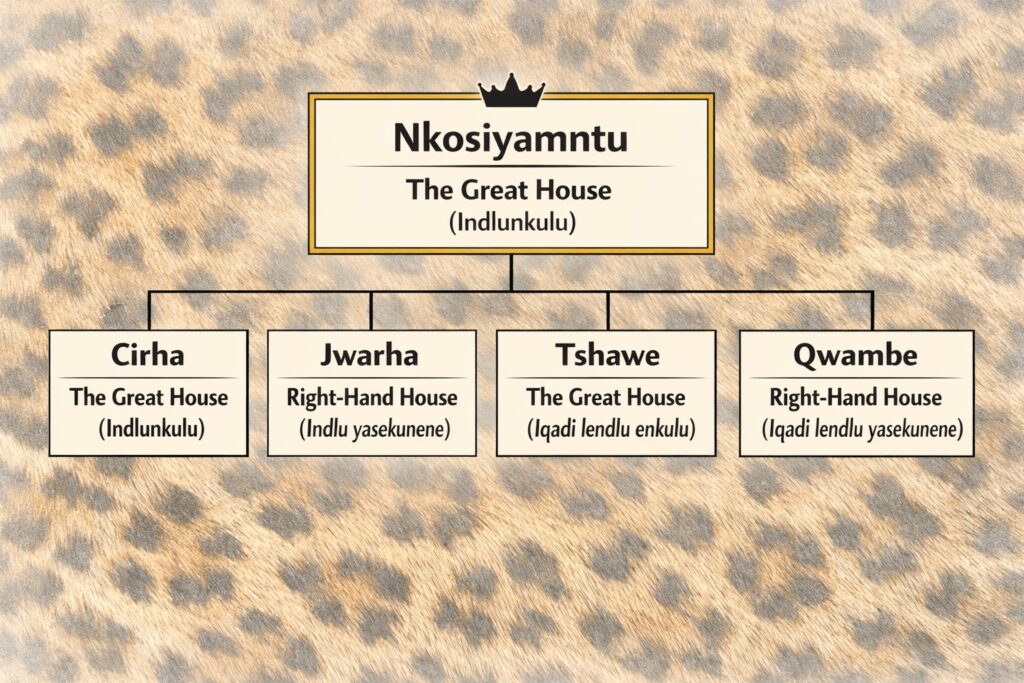
Such distortion legitimised dispossession upon the foundation of the falsehoods promulgated from 1652, thereby obscuring the pre-colonial sovereignty and rightful succession that had long governed the nation (Mellet, 2024). This was, in essence, an ideological superstructure in service of imperialism and the base of racial capitalism. The erasure of AmaCirha, AmaJwarha, OoNgconde, AmaQwambe, and their aristocracy Royal Clans became a matter of necessity to the colonial order, for their existence constituted a historical bloc of such gravitas as to contest colonial hegemony. In place of truth, the Pre-colonial Royal Monarchy Governance and Leadership of AmaXhosa Omthonyama were set aside, and in their stead were installed distorted genealogies and families, contrary to the original organisational hierarchy, as depicted in Figure 1.
Figure 1: The Royal House of Nkosiyamntu Hierarchy (Source: Tsibani 2020, Chapter 6)
Given the reconfiguration of the AmaXhosa organogram or governance hierarchy into a colonial and apartheid hierarchy, wherein the Right Hand House of the Great House assumed Kingship through the Bantu Authorities framework and successive Traditional Acts of Parliament, as depicted in Figure 1 above, the voice of reason arose in Ntsikana Gabha. His trajectory stands in marked contrast to the impositions of colonial design. His prophetic and political counsel, “zenibe yimbumba yamanyama”, be united as one, like a rock. His lofty advice became a doctrine of political unity, steadfastly grounded in the defence of land, identity, and stable succession within Royal Monarchy Governance and Leadership. The charge to transmit this message from Lagwada kaMlawu, to Ndabanduna, and thence to Zanzolo of the AmaThembu Royal Monarchy, established a custodial chain for national cohesion by Royal Leaders, that the realm might endure beyond the tempests of its time. Understood in the Royal Monarchy register, it is a warning against the love of money, for money is produced from mineral resources and its love becomes a cancer that corrodes lineage, land and governance ( zeningalithathi igqosha elingenamgxuma). Ntsikana’s counsel thus anticipates a liberation ethic that integrates unity, restitution and governance under the authority of the King or Queen and prefigures the anti-imperialist unity later theorised within the national liberation movement. Accordingly, the African Royal Monarchies of AmaXhosa are rooted in the philosophy that “the King or Queen never dies”. The Latin rendering, Rex vel Regina numquam moritur, captures the principle of institutional continuity: the office endures beyond the individual, and succession follows the Royal House’s own Royal Governance and Leadership plan, not external political acts. In practice, succession is determined by the Royal House’s internal succession plan rather than by “coup d’état, tribalism, or statutory traditional acts imposed during colonial, apartheid, post-colonial Africa and post-apartheid South Africa”. When a monarch passes, the office persists and the rightful successor is identified through established genealogical and constitutional protocols of the Royal House. This contrasts with colonial and post-colonial interventions that replaced hereditary succession with administrative appointments, parliamentary statutes and politicised processes, which severed the Royal Monarchy from its historical subjectivity and subjected it to external political expediency.
- TWO INTERLINKED ACTS OF REMEMBRANCE
The doctrine materialised in two interlinked acts of remembrance. On 10 May 1891, Dr Rubusana launched the Imbumba yamaNyama Congress in Ngqeberha, reviving the 1882 Council and reasserting the political voice of the opposition, including the Royal House of King Nkosiyamntu against the erasure of its constituent clans. On 10 May 1994, President Mandela was inaugurated as the first democratically elected President of the Republic of South Africa. The symmetry of dates is no coincidence in history. It is the symbolism of continuity. As articulated in the Freedom Charter of 1955 and AU Agenda 2063, the historic mission of building a united, non-racial, non-sexist, democratic and prosperous South Africa remains incomplete without the restitution and recognition of the Royal Monarchies that predated colonial conquest.
- CONCLUSION AND ROAD AHEAD
On Distorted Genealogies, Broken Foundations, and the Duty of Righteous Leadership
The distortion of genealogies is not a clerical error. It is an act of statecraft that severs a people from history, identity, culture, belonging, and pride. When colonial and apartheid administrations recast the sovereign lineages of African Royal Monarchies, they fractured the very foundation upon which constitutional order, succession, and communal dignity rest. Such distortion, entrenched through Traditional Acts of Parliament and the Department of Native Affairs (DNA), became an ideological superstructure serving racial capitalism and imperial accumulation. The consequences were neither abstract nor benign. The retribalisation policies of the 1970s, the brokenness engineered under P.W. Botha’s statecraft for so-called “Coloured” persons, and the Tricameral Parliament of 1983 institutionalised factionalism and regionalism as instruments of rule. These contrivances did not merely administer people; they manufactured “firstness” and “other-ness” (Mellet, 2024), setting clan against clan, region against region, and thereby ensuring that the historical bloc capable of contesting colonial hegemony remained divided. A foundation deliberately broken cannot, by its nature, stand the test of time. It can only reproduce tribalism, retribalism, and the political alienation that Marxist-Leninist analysis identifies as the separation of a people from their material and historical agency.
When the foundational order is broken, the duty of righteous leadership is restoration, not accommodation. Philosophy instructs that legitimacy derives from truth, and truth in the realm of Royal Monarchy Governance demands accurate, scientific historiography, not the quasi-mythical stories and colonial archives that have long masqueraded as evidence. The case of AmaCirha, as a microcosm of defeated Royal Monarchies in post-colonial Africa and post-apartheid South Africa, exposes the inconsistencies of law under neoliberal dispensations. Determinations concerning the Royal House of King Nkosiyamntu cannot rest upon colonial narratives and apologist chronicles that naturalised dispossession from 1652 onward. They require a meta-analysis of oral testimony, pre-colonial constitutional practice, and archival correction, a scholarly wisdom that restores culture, reclaims belonging, and reinstates pride. As Tsibani reminds us, leadership in a fragile world must be aesthetic and ethical: it must bind what was broken and speak truth to structures of distortion. Only through such rectification can the Crown’s dignity, the people’s identity, and the realm’s continuity be secured against the factionalism that broken foundations beget.
The study finds that British Indirect Rule from 1846, Bantu Authorities of the 1950s, retribalisation policies of the 1950s to 1970s, and the 1983 Tricameral Parliament institutionalised factionalism as statecraft. These interventions supplanted the African Royal Monarchy Governance and Leadership Model with contrived hierarchies, producing political alienation and erasure of AmaCirha, AmaJwarha, AmaTshawe and allied clans. Determinations resting on colonial archives cannot sustain constitutional justice. Therefore, from 2026 to 2063, “zenibe yimbumba yamanyama” must be read within the Republic’s engagement with the African Union (AU) Agenda 2063. Agenda 2063 envisions an integrated, prosperous and peaceful Africa driven by its citizens. Its realisation requires the decolonisation of governance and the restitution of pre-colonial institutions suppressed under colonialism of a special type. The persistence of British Indirect Rule architecture continues to obscure the legitimacy and continuity of Royal Monarchy Governance and Leadership. The silence of colonial writers, apologists and apartheid beneficiaries has contributed to the alienation of AmaCirha, AmaJwarha, AmaXandeshe, AmaKwayi, AmaQwambe and other Royal Clans that form part of King Nkosiyamntu Aristocracy (Ibhunga lakoMkhulu) from the political landscape. Yet, it has been founded during inclusive dialogue sessions held between 14 March 2014 and 23 March 2023 with Imbumba yamaNyama Royal Council dialogue sessions at the University of Fort Hare, complemented oral evidence from Ngoni Royal Monarchies, sustaining the centrality of AmaCirha, AmaJwarha, AmaKwayi, AmaQwambe, AmaXandeshe and allied clans in the restoration of defeated Royal Monarchies. In these productive engagement sessions between 2014 and 2023, aforesaid, “zenibe yimbumba yamanyama” operates as a national call for unity against fragmentation, for land restitution and redistribution, and for the alignment of Royal Monarchy Governance with AU Agenda 2063: African identity, self-reliance, peace and Pan-African solidarity.
Notwithstanding the above, a historiography that integrates symbolism, chronology and prophetic narrative is essential to reversing this erasure. The work of Mellet (2024) on Cape slavery and the lies of 1652, read alongside oral histories preserved within the Royal House and Tsibani’s Aesthetic Leadership in our Fragile World (2018), provides a corrective to colonial archives that have sought to naturalise dispossession. Restoring the memory and political agency of AmaCirha, AmaJwarha, AmaTshawe, AmaKwayi kaTogu, AmaXandeshe, AmaQwabe, OoLetha, AmaNgwevu, AmaKhomazi, AmaMfene, ooNzotho, ooThangana, AmaQocwa, AmaGqiqwa, AmaSukwini, AmaQwashu, OoXharha, OoSithathu and others is not nostalgia, but a demand for historical accuracy and constitutional justice, consistent with the Marxist-Leninist imperative to recover the historical subjectivity of oppressed and defeated Royal Monarchies between the 1460s and 1948 in South Africa one hand. On the other hand, restoring Ngoni (Holy people with integrity), Royal Monarchies and Inkwe (IiNgqwayingqwayi or juristic persons) and San (AbaNtu baseNtabeni or AbaThwa or sacred persons of God) will be critical for decolonisation of distorted histories. In the register of Royal Monarchy professional communication, Ntsikana Gabha’s counsel constitutes a charter for unity against fragmentation, a framework for land and cultural restitution, and a foundation for a South African democracy that acknowledges its pre-colonial antecedents leading to the formation of liberation movements and approval of the Freedom Charter in 1955 as a minimum framework for unity to address the national question. Reconciliation cannot be secured whilst foundations remain distorted, for distorted histories do not lead to prosperity, growth and development.
To advance the meaning of “zenibe yimbumba yamanyama” is to affirm that unity is not uniformity imposed from above, but a covenant of distinct clans bound by shared history, land and responsibility. It is to reject the alienation embedded in racial capitalism and to insist that the restoration of the Royal Monarchy of AmaXhosa (Ngoni in the Old Cape Province), Inkwe (Khoe) and San (AbaThwa) is integral to building a better life for all. Only through such recognition can South Africa move from the symbolism of 10 May 1994 to the substance of a truly reconciled and historically grounded nation, aligned with the African Union (AU) Agenda 2063 and beyond. The remembrance of 10 May must therefore honour both inaugurations: that of Mandela in 1994, and that of Imbumba yamaNyama in Ngqeberha in 1891, for one fulfilled the promise of the other.
DISCLAIMER
Prof. Fumene George Tsibani is a Water Governance and Political Analyst at the University of Johannesburg. He writes in his personal capacity. The views expressed are his own and do not represent the views of the University of Johannesburg.
REFERENCES
African National Congress. 1955. The Freedom Charter. Kliptown: Congress of the People.
African Union. 2015. Agenda 2063: The Africa We Want. Addis Ababa: African Union Commission.
Lenin, V. I. 1917. Imperialism, the Highest Stage of Capitalism. Petrograd: Zhizn i Znanie.
Mellet, P. T. 1994. The Lie of 1652: A Contested History of South Africa. Cape Town: Kwela Books.
Mellet, P. T. 2024. Cape Slavery. Cape Town: Kwela Books.
Rubusana, W. B. 1911. Zemk’ iinkomo Magwalandini. London: Lovedale Press.
Tsibani, F. G. 2020. Nation Building Plan between 2020 & 2064: Designing Paradise Cities to Restore PRIDE through WEALTH Creation. [Wellington, Western Cape, Republic of South Africa]: [Urlink Print & Media, LLC.
Tsibani, F. G. 2018. Aesthetic Leadership in our Fragile World. Hessequa: Hessequa Municipality.
Ntsikana Gabha. Oral traditions, as recorded in Imbumba yamaNyama Royal Council archives, 1882-1891. – @NewsSA_Online
Follow us on our social media platforms below: