By Thobile Jiwulane:
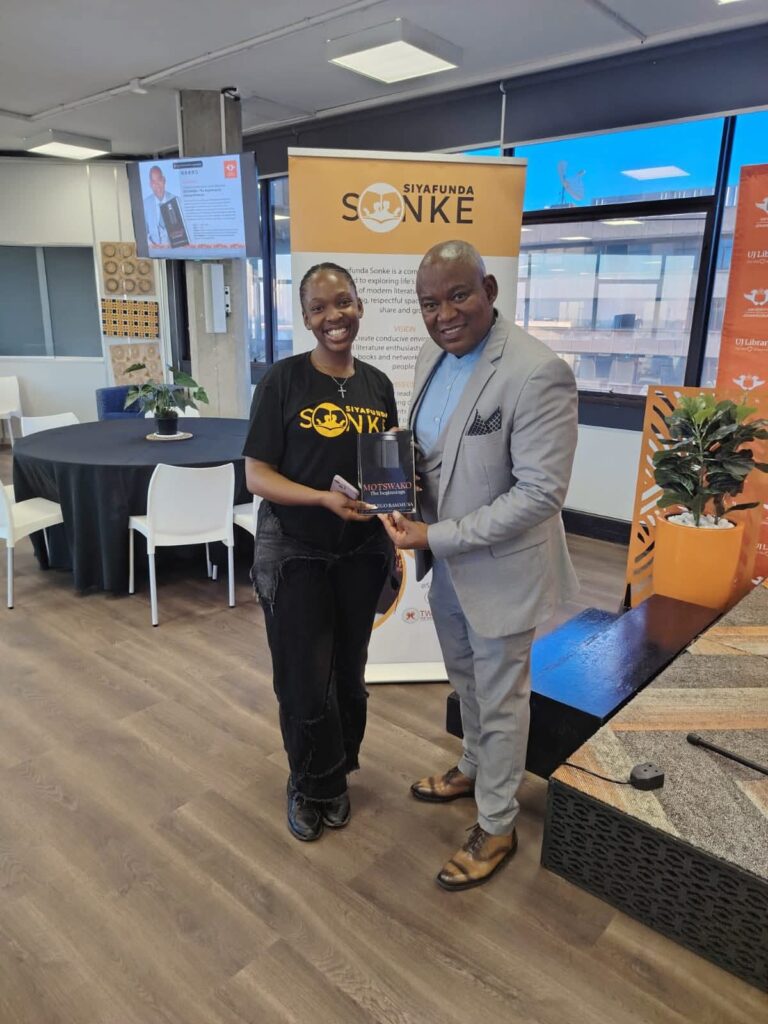
Katlego Rammusa — author, music enthusiast, and proud son of Mafikeng — was showered with words of appreciation at the University of Johannesburg Library, where he discussed his acclaimed book ‘Motswako: The Beginnings’. The event formed part of UJ’s Africa Month celebrations, designed to advance critical dialogue through literature, culture, and scholarship. The conversation was facilitated by a knowledgeable host, Thapelo Khambule, a UJ Library researcher, who guided the audience through Rammusa’s journey with warmth and insight.
For Katlego, speaking about Motswako is second nature. The genre was born in his community, Maftown, and he was part of the movement that grew from its dusty streets. He recalled how a casual conversation with a friend sparked the idea for the book. “Why don’t you write a book?” the friend suggested — and the rest, as he put it, is history. That encouragement, coupled with his deep knowledge of the arts, became the foundation of a work that now stands as a legacy for the genre.
With passion and pride, Katlego explained how Motswako shaped pop culture in the North West and beyond. He reminded the audience that just as Soweto gave birth to Kwaito, Mafikeng gave the nation Motswako. When asked about the genre’s originator, he acknowledged the tensions among artists who claim ownership but insisted that Motswako was a collective creation of the kasi streets. “When you talk about the founder of Motswako, you are talking about Prof Sobukwe,” he said, linking the genre’s spirit to broader cultural resistance. He was referring to Prof Sobukwe of the Baphixile duo.
Rammusa, who has rubbed shoulders with leading artists, shared anecdotes that revealed Motswako’s wide appeal. He recalled an elderly woman who confidently identified the late artist, HHP, as one of the genre’s defining voices, proof that Motswako resonated across generations. His book, he explained, was his contribution to preserving that legacy: “It’s a legacy for the genre of Motswako, I am proud of the Maftown initiative.”
In the wide-ranging discussion with Khambule about the book inspirations, he also reflected on the role of the music, arts and culture centre established under the former Bophuthatswana government in Mafikeng to nurture young talent, which kept young people engaged and away from drugs. “Mmabana kept us busy in the studio and off the streets and away from drugs,” he said, noting how the infrastructure helped nurture talents. The Motswako genre inspired many artists who sang English R&B and Pop to switch to Motswako. Katlego spoke fondly of the humility of artists like HHP and even his own friend, Khuli Chana, both whose presence in the industry inspired young musicians to believe in their craft.
The discussion broadened to the challenges facing musicians today. Audience members raised concerns about artists who die in poverty despite their fame. Some attributed this to a lack of understanding of the business side of music. Katlego agreed, stressing the importance of mastering value chains. “Some artists produce great labels but fail to understand the business. They end up destitute because they don’t manage their earnings,” he warned. He emphasised that visibility and credibility are crucial: “You can record with the biggest company, but if you are unknown, you are going nowhere.”
Adding to the dialogue, Councillor Thapelo Amad, Johannesburg’s MMC for Community Development, highlighted opportunities for young artists at the metro. He spoke of funding initiatives and assistance for royalties to benefit locals and announced about training plans for boot camps, and programmes designed to help musicians understand production, publishing, and royalties. “We have to serve you. We are a country alive with possibilities. We will work with you because you have started something,” Amad assured the youth who attended.
The event drew students, aspiring musicians, industry veterans and faculty representatives, all united by their love for Motswako. Their contributions in the form of questions and comments enriched the discussion, underscoring the genre’s enduring relevance and the need to safeguard its future. For Katlego Rammusa, the evening was more than a book launch and exposure — it was a celebration of a cultural movement that continues to inspire, challenge, and unite South Africans. – @NewsSA_Online
Follow us on our social media platforms below: