By Fumene George Tsibani:
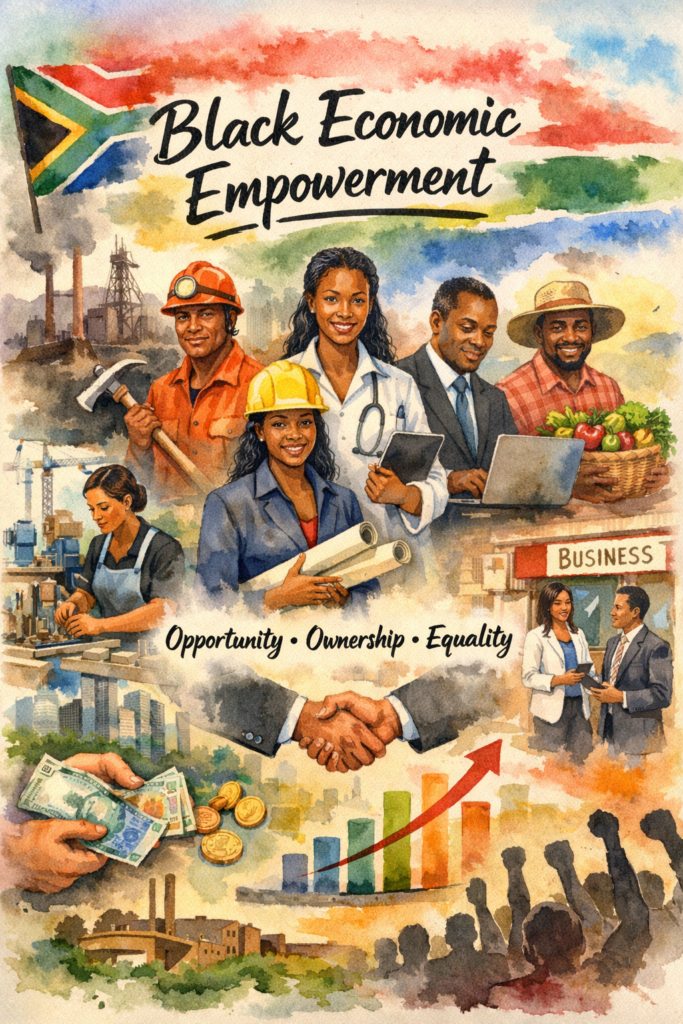
South Africa’s transformation project cannot be assessed without interrogating the instruments that were designed to alter ownership, control and participation in the economy. The movement from Black Economic Empowerment (BEE) to Broad-Based Black Economic Empowerment (BBBEE) represents a policy evolution, yet it has not resolved the structural inequalities that continue to undermine growth, inclusion and democratic legitimacy. As Dr Pali Lehohla argues in The Untold Story of South Africa’s Economic and Democratic Decline, “mining and finance have played a central role in widening inequality and limiting opportunities for future generations” (Lehohla, 2026:3).
- Conceptual and Legislative Distinctions
Black Economic Empowerment (BEE) emerged in the late 1990s as a mechanism to transfer equity and management control to previously disadvantaged individuals. In practice, it produced a narrow, elite-focused outcome that concentrated benefits among a small group with political proximity. The Broad-Based Black Economic Empowerment Act 53 of 2003 introduced Broad-Based Black Economic Empowerment (BBBEE) with the express intention of widening participation. BBBEE expanded the scorecard to include ownership, management control, skills development, enterprise and supplier development, and socio-economic development. The legislative intent was to shift from enrichment of a few to empowerment of many, yet the outcomes have been uneven and contested. - Critical Perspectives on Objectives and Outcomes
Moeletsi Mbeki offers a penetrating critique of the underlying objectives of BEE as conceptualised by big business. He contends that Duma misunderstands the main objectives of BEE as conceptualised by big business. In his view, the first objective was “to buy off and co-opt leaders of the liberation struggle so they did not implement the economic prescriptions of the Freedom Charter, especially nationalising of monopoly industries” (Mbeki, 2025). This, he argues, succeeded because there has been no implementation of economic clauses of the Freedom Charter, and the first phase of BEE targeted African National Congress (ANC) and Mass Democratic Movement (MDM) leaders.
The second objective, according to Mbeki, was “to ‘sell capitalism’ as a humane system whose (white) managers must be allowed to run it for the benefit of all” (Mbeki, 2025). He notes that this explains why the new phase of BEE targeted a broader group of black people as shareholders but not as managers of white companies. Enterprise development was encouraged, yet there have been no sustained demands for restructuring how big businesses are managed. Mbeki concludes that “white capitalists in South Africa” have preserved managerial control while diffusing shareholding, thereby maintaining the architecture of accumulation.
- Failures of Democracy and Implications, 2026 to 2063
The economic crisis cannot be separated from democratic decline. As voter turnout continues to decline, South Africa is approaching a dangerous tipping point. Democracy depends on citizen participation, and an absent electorate creates space for power brokers, factions and political warlords to fill the vacuum left by public disengagement. Lehohla warns that “each generation could become poorer than its parents”, which represents a fundamental break in the social contract (Lehohla, 2026:7).
Between 2026 and 2063, the implications are profound. First, persistent economic exclusion will erode the legitimacy of democratic institutions, as citizens perceive elections as delivering representation without redistribution. Second, youth unemployment and intergenerational poverty will intensify social instability, making long-term planning impossible. Third, knowledge generated by institutions such as Statistics South Africa has been “wasted on government institutions unable or unwilling to act on them” (Lehohla, 2026:12), meaning that policy will continue to be reactive rather than evidence-led. Fourth, without structural reform, South Africa risks a post-democratic condition in which formal electoral processes exist alongside concentrated economic power that is unaccountable to the electorate.
- The Required Economic Model
The required model must move beyond compliance to capability, and beyond transfer to transformation. It must be anchored on productive transformation through beneficiation, manufacturing and agro-processing to reduce dependence on extractive sectors. It must place knowledge directly in the hands of citizens, because informed societies, not informed governments, are the true agents of change. It must also address the cost of capital and the dominance of financialisation, so that savings are channelled into labour-absorbing investment rather than asset speculation.
BBBEE corrected the narrowness of BEE, but it has not delivered broad-based prosperity. If South Africa is to honour the promise that each generation will inherit a better life, policy must integrate transformation with productivity, inclusion with competitiveness, and democracy with development. The period 2026 to 2063 will be decisive, and the choice is between scorecard compliance and structural redesign.- @NewsSA_Online
References
Lehohla, P. 2026. The Untold Story of South Africa’s Economic and Democratic Decline. Johannesburg: Jacana Media.
Mbeki, M. 2025. Correspondence on BEE objectives and the Freedom Charter. Personal communication, 14 April.
Follow us on our social media platforms below: