By Dr Zamani Saul:
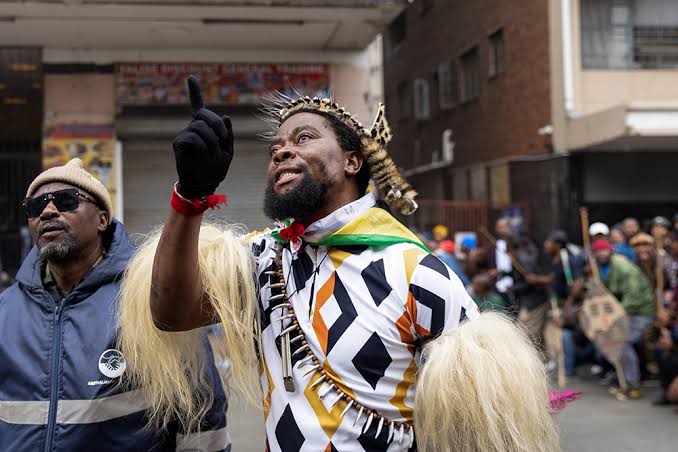
First, it is essential to acknowledge the politically astute and proactive manner in which the national government responded to the 30 June ultimatum for undocumented migrants to leave. What the government did was to reframe the protests of March & March into a vital grievance mechanism rather than a challenge to the legitimacy of the State. The government acknowledged that there is a slow pace in addressing the frustrations raised by March & March and, in the same vein, equally condemned any form of unlawful and violent activities directed to other people and property. The message was loud and clear that those participants in March & March programmes who embark on illegal and violent activities will be arrested.
Conversely, the Arab leaders who were engulfed by the Arab Spring in North Africa and the Middle East chose to deploy delegitimising tactics when confronted with a similar situation as South Africa. When the Arab Spring of 2011 started, the political establishment accused the organisers of being “guided and influenced by the dirty hand of the West” with an “anti-Islamic agenda.” Instead of responding to the triggers of the uprising, they dismissed the popular dissent as foreign-funded subversion. This was followed by extensive investigations of the bank accounts of the organisers and a securitisation process that ultimately led to violent crackdowns. So, what was labelled as foreign-funded subversion became a turning point for the Arab world.
The negative labelling by the political establishment in Tunisia was based on a disastrous misunderstanding of the impact of social agency of the marginalised masses yearning for change. The whole Arab Spring started when a young man aged 26, Tayeb Mohamed Bouazizi, a fruit and vegetable street vendor in Tunisia, burned himself to death when local police confiscated his cart and humiliated him when he tried to get it back; that is when protests started and spread throughout Tunisia.
The lesson from what happened in Tunisia is not to laugh off and ridicule the organisers of March & March because they are considered unsophisticated people using our arbitrary standards to judge them. The impetus behind such social movements often stems from tangible local crises, much like the conditions that triggered the Arab Spring. By recognising these mobilisations as reflections of persistent societal tensions, the government can effectively create space for addressing these structural challenges that trigger and fuel collective action.
It is unfortunate to note that some leaders in South Africa are falling into a trap of deploying “counter-revolutionary” narratives, even asking questions about the funding of the March & March programmes. The deployment of these narratives is meant to dismiss and delegitimise grassroots activism by the marginalised to obscure accountability. As seen during the Arab Spring, these delegitimising tactics do not work; rather, they backfire.
Investigating the sources of funding of March & March might be the right thing to do, but more important is the grievance tabled by March & March about the lethargic enforcement of migration laws, which results in the flooding of South African streets and the labour market by undocumented migrants, not only from other African countries but Asia as well. This is what is at the heart of the social mobilisation, not a change of government or the system of government.
Political elites have a tendency to negatively characterise social mobilisation initiatives that they do not have control over. Social mobilisation is what was called “mass mobilisation for people’s power” in the past. March & March is manifestly a social mobilisation movement by social forces for non-political ends in the face of growing popular discontent regarding ineffective enforcement of migration laws.
This kind of social mobilisation is not unusual or counter-revolutionary in a country with a constitutional democracy founded on a strong civic tradition. This civic tradition introduced a new phenomenon of “social mobilisation of the disgruntled,” mainly poor citizens. This social mobilisation often evokes continuities in cultural expression and practices – slogans, dance, and style of speeches.
Equally and interestingly, in the 1980s, there were elements of cultural strands, though insignificant, that influenced the struggle against apartheid colonialism. The fact that there is social mobilisation that we are unable to control should not make us fall back to labelling but to a compassionate understanding of the grievances.
With the decline in the legitimacy of party politics in South Africa, social mobilisation will continue to be a terrain for the poor to articulate their concerns. The issue of enforcement of migration laws is a genuine social concern that should be addressed in a pragmatic manner by a responsive government without labelling those who mobilise communities around this concern. Therefore, March&March is a true testimony to the fact that South Africa is not a neo-patrimonial society, where the political elite (patron) dominate, in a self-serving manner, both the political and social discourse by manipulating the marginalised groups (clients) into inaction.
Over the past few weeks, the country has been in a grip of public discourse generated by the marginalised and not palace politics of commissions, coalitions, leadership contests, elections, conference of the left, etc. The president had to call a “family meeting” due to the pressure exerted through social mobilisation that led to increased government accountability, and there is nothing counter-revolutionary about that.
Yes, opportunistic and counter-revolutionary forces, like the MK Party, will seek to exploit the situation, as spontaneous social mobilisation and upheavals serve as fertile ground for a counter-revolution. It is here that it becomes the responsibility of progressive formations and leaders to patiently instil revolutionary and emancipatory consciousness and practices to those responsible for the social mobilisation movements and not to label and pigeonhole them.
There is something that we can learn from March & March – how people in severe social and economic despair can easily fall back on tribal loyalties and abandon abstract nationhood. It is essential to note that the historical interlude between the French and Russian revolutions witnessed mass ideologies and movements of counter-revolution, often racialised and ultra-nationalist in character. A counter-revolution is broadly understood as an organised movement, typically led by established elites, that aims to reverse progressive changes and transformation. March & March might manifest symptoms of being ultra-nationalist in character, but it is definitely not a counter-revolution.
Dr. Zamani Saul is the Northern Cape ANC Provincial Chairperson. The article is derived from Saul’s Facebook page.- @NewsSA_Online
Follow us on our social media platforms below: