By Thobile Jiwulane:

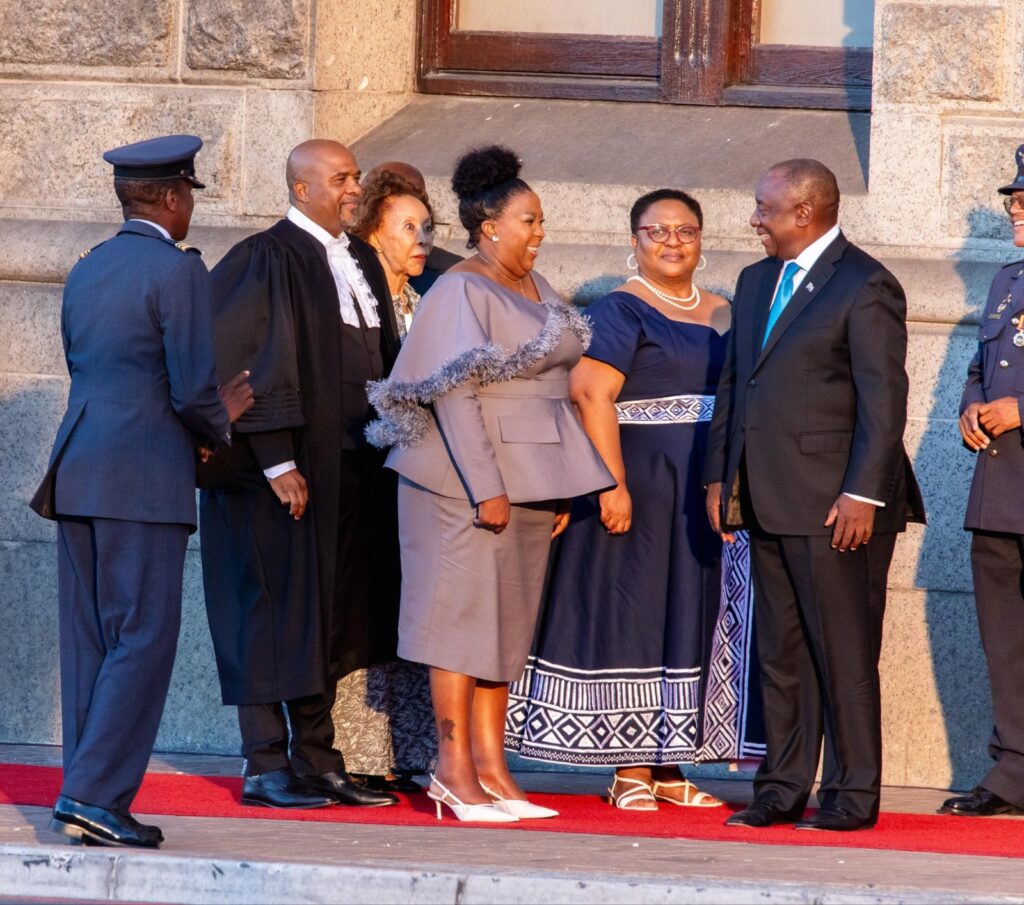
President Cyril Ramaphosa struck an optimistic tone in his second State of the Nation Address (SONA) under the Government of National Unity (GNU), telling Parliament on Thursday evening that the multiparty coalition has made progress in stabilising the economy. He announced new measures to tackle crime and corruption, including the deployment of the army to hotspots plagued by gang violence and illegal mining.
Ramaphosa used the occasion to link present challenges with historic milestones, paying tribute to the 1956 women who marched against pass laws, the 1976 youth who resisted Afrikaans in black schools, and the adoption of South Africa’s Constitution in 1996. Reflecting on the GNU’s work since its formation after the May 2024 general election, the President said the country was on a stronger footing:
Ramaphosa stated: “As we reflect on the state of our nation, we can say that we are stronger today than we were a year ago. Our economy is growing again, and this growth is gathering pace. While we have experienced four consecutive quarters of GDP growth, we know that it has to grow much faster to meet our social and economic challenges.” He highlighted achievements in economic recovery and anti-crime initiatives, positioning the GNU as a stabilising force in a turbulent period.
Key Achievements Highlighted by Ramaphosa:
• Fiscal discipline: Two consecutive primary budget surpluses.
• Improved outlook: Credit rating upgrades, falling interest rates, and inflation at its lowest in 20 years.
• Debt stabilisation: Clear path to managing and reducing national debt.
• Currency strength: Rand has gained against the dollar.
• Market performance: Johannesburg Stock Exchange delivered exceptional results over the past year.
• Investor confidence: Broader economic recovery driving renewed interest in South African equities.
• Lower borrowing costs: Decline in the cost of raising capital.
• Economic reform: Operation Vulindlela is accelerating reforms, opening space for investment and competition.
• Energy resilience: Load shedding ended; a more dynamic and resilient energy system was built.
• Transport revival: Ports and freight rail are improving, with rising volumes of goods moved in and out of the country.
• Passenger rail restored: More commuters now travel on new locally-made trains.
• Infrastructure drive: Nationwide investment in roads, bridges, rail lines, ports, dams, and renewable energy projects.
• Job creation: Over 2.5 million opportunities created through the Presidential Employment Stimulus, especially for youth and women.
• Expanded programmes: Public Works and Community Work Programmes continue to provide jobs.
• Education milestone: 2025 saw the highest matric pass rate in history, with two-thirds of bachelor’s passes from disadvantaged schools.
• Declining unemployment: Joblessness beginning to ease as the economy grows.
• Social relief: SRD Grant reduced the number of people living in food poverty.
• Anti-corruption gains: Strengthened laws and removal from the FATF grey list on money laundering and terrorism financing.
• Institutional recovery: Progress in rebuilding institutions weakened by state capture.
• Revenue authority restored: SARS once again recognised as a world-class tax agency.
• Prosecutions advancing: Investigating Directorate Against Corruption pursuing high-profile cases.
• Democracy maturing: South Africa’s democratic system described as ‘stronger’ and ‘more resilient’.
Ramaphosa urges unity, warns against “easy victories” in SONA
Ramaphosa used his SONA to highlight progress under the GNU, while cautioning that South Africa’s challenges remain far from resolved. “The Government of National Unity has shown that it is possible for South Africans to come together from across the political spectrum to work on a common agenda for growth and progress. Last year, we hosted the leaders of the world for a successful G20 Summit, which showcased our country’s strength on the global stage. Confidence is rising among investors, businesses and consumers. These improvements are the result of a determined effort across government and all of society. They show what is possible when we work with unity and purpose,” Ramaphosa said.
But he tempered optimism with realism, warning against complacency: “Now, we have a unique window of opportunity to translate these gains into sustained growth. Despite this progress, we must be honest about the challenges we still face. Although we are moving forward, we must not claim any easy victories. We are still far from where we need to be. For too many people, life remains hard. Jobs are scarce and opportunity is out of reach.
South Africans are worried about violent crime and corruption. They are concerned about the state of local government and its inability to deliver basic services in many parts of the country. Above all, they are desperate for work and for an income to support their families.” Ramaphosa’s remarks underscored the delicate balance facing the GNU – celebrating economic recovery and rising investor confidence, while acknowledging the urgency of tackling unemployment, crime, corruption, and service delivery failures.
Vows tougher stance on crime, outlines GNU priorities
Ramaphosa used his State of the Nation Address to call for unity and equality, pledging that the Government of National Unity (GNU) will focus on inclusive growth, poverty reduction, and building a capable, ethical state.
“We can only be strong when we are equal, when the progress we have made is shared by all South Africans. The Constitution calls on us to work towards a society in which every South African has a fair chance to make a better life for themselves. In which every child receives a decent education and an opportunity to work and thrive. A society in which we reclaim our public spaces and meet one another in the street as equals. In which the state works for the people and the corrupt face consequences,” Ramaphosa said.
He outlined three strategic priorities for the GNU this year: driving inclusive growth and job creation, reducing poverty and the high cost of living, and strengthening the capacity of the state. But he stressed that prosperity must rest on safety and security.
Ramaphosa painted a stark picture of the toll crime takes on society: lives lost, businesses reluctant to invest, children caught in gang crossfire in the Western Cape, residents displaced by illegal miners in Gauteng, and women murdered by their partners. He said such violence must end, and expressed confidence that change is possible.
“Organised crime is now the most immediate threat to our democracy, our society and our economic development. Our primary focus this year is on stepping up the fight against organised crime and criminal syndicates, using technology, intelligence and integrated law enforcement. We will tackle organised crime by consolidating intelligence at the national level, identifying priority syndicates and deploying hand-picked, multidisciplinary intervention teams focused on dismantling criminal networks,” Ramaphosa said. His remarks underscored the GNU’s dual mission: advancing economic recovery while confronting the country’s most urgent security threats.
Army to be deployed and a crackdown on gangs and corruption
He announced sweeping measures to combat gang violence, illegal mining, and organised crime, including the deployment of the South African National Defence Force (SANDF) to support police operations in hotspots across the Western Cape and Gauteng.
“To strengthen our fight against gang violence, I am deploying the South African National Defence Force to support the police, as we did to great effect with illegal mining. I have directed the Minister of Police and the SANDF to develop a tactical plan on where our security forces should be deployed within the next few days in the Western Cape and Gauteng to deal with gang violence and illegal mining,” Ramaphosa said. He added that Parliament would be informed of the timing, location, and cost of the deployment in line with constitutional requirements.
The President said the government would intensify enforcement of gun laws and expand police capacity, with 5,500 new recruits joining the South African Police Service (SAPS) this year. This adds to the 20,000 officers announced in previous State of the Nation Addresses.
He also revealed that SAPS has established a task team to pursue investigations arising from the Madlanga Commission, with the State Security Agency set to re-vet senior police and metro police management through lifestyle audits. The commission’s findings, he said, would drive far-reaching reforms. Ramaphosa further announced a crackdown on organised crime, corruption, and the illicit firearms trade. A dedicated team in the Presidency will oversee reforms across the system, while the Special Investigating Unit, the National Prosecuting Authority, and the Hawks will be strengthened to intensify the fight against corruption.
Pledging to protect whistle-blowers and to tackle the water crisis
According to Ramaphosa, new measures would be implemented to strengthen the fight against corruption, including the introduction of a Whistle-Blower Protection Bill in Parliament. The legislation will criminalise retaliation against whistle-blowers and provide psychosocial, legal and financial support for those who expose graft. To clean up procurement, the government will roll out new technology systems and finalise regulations under the Public Procurement Act by mid-2026.
Turning to the nationwide water crisis, the President acknowledged that water has become the most pressing issue for many South Africans, from Johannesburg to Knysna and rural Giyani. Ramaphosa blamed poor planning and neglected infrastructure for the crisis, warning that taps will continue to run dry unless municipalities improve maintenance. He said the government has committed more than R156 billion over the next three years to water and sanitation projects, including the Lesotho Highlands Water Project and the Ntabelanga Dam in the Eastern Cape. Ramaphosa cautioned that under the forthcoming Water Services Amendment Bill, providers who fail to deliver will risk losing their licences.
He announces National Water Crisis Committee, vows accountability
Ramaphosa has announced the creation of a National Water Crisis Committee to coordinate the state’s response to widespread water outages across South Africa. The committee, chaired by the President himself, will bring together technical experts and resources from the national government and municipalities facing shortages.
He warned that the government would use its constitutional powers to intervene in failing municipalities and hold officials accountable. Criminal charges have already been laid against 56 municipalities, and Ramaphosa said charges would now be extended to municipal managers personally for violating the National Water Act. Water outages are a symptom of a local government system that is not working, he said, adding that a far-reaching overhaul is underway to address dysfunction in municipalities where administrations are weak and governed by patronage rather than technical capacity.
Alongside the water crisis, Ramaphosa addressed the outbreak of foot-and-mouth disease, announcing a mass vaccination programme for the national herd of 14 million cattle. The plan requires 28 million doses over the next 12 months, with vaccines procured centrally to match the specific strain of the virus in South Africa. The country’s farmers have lost a large number of cattle heads due to the pandemic, which has also impacted sales in the beef industry. It initially relied on a vaccine produced in neighbouring Botswana and until a local vaccine was researched and produced to be rolled out countrywide in an attempt to overcome the scourge. – @NewsSA_Online
Follow us on our social media platforms below: