The Moot offers more than a tribute to a jurist, it offers a platform for intellectual succession.
BY ZOLA PINDA:
Beyond the Ceremony
On 7 August 2026, at the University of Fort Hare in the Eastern Cape, Justice Mbuyiseli Madlanga stood before a generation of young law students whose professional lives may extend well into the second half of this century.
The occasion was the launch of the Justice Mbuyiseli Madlanga International Moot Court Competition, an initiative of Fort Hare’s Faculty of Law. It was, on the surface, an academic ceremony honouring a distinguished jurist. Yet its deeper significance lay in the meeting of three forms of institutional responsibility: the experience of a jurist, the stewardship of a law faculty and the intellectual potential of young people preparing to enter the legal profession.
That intersection deserves attention beyond the ceremony itself.
A constitutional democracy is sustained not only by constitutions, courts and legislation, but by citizens and professionals who understand why those institutions exist and possess the intellectual confidence to defend them. The Moot provides a practical environment in which that understanding can be cultivated.
A Moot Is More Than a Competition
A serious moot court is not simply a rehearsal for future courtroom appearances. Students are required to research difficult questions, distinguish competing legal principles, construct arguments and defend their reasoning under scrutiny. The exercise teaches lessons that extend beyond legal practice: authority is not infallibility, confidence is not evidence, and an argument must withstand examination before it can claim intellectual legitimacy.
Those are legal disciplines, but they are also democratic disciplines. In societies where public institutions are tested by political pressure, misinformation and competing claims to authority, the ability to reason independently is a form of civic resilience. That is why the Madlanga Moot matters. Properly developed, it can become more than a competition; it can become a laboratory for constitutional citizenship.
Why Madlanga’s Legacy Matters
Justice Madlanga’s career gives the initiative particular resonance. His professional journey has encompassed legal practice, academia and judicial office within South Africa’s constitutional order. Yet the most appropriate way to honour a jurist is not necessarily through admiration. It is through intellectual engagement.
Students should be encouraged to study judgments critically, understand the reasoning behind them, identify weaknesses in arguments and construct alternative interpretations where the law permits. A constitutional tradition remains alive only when succeeding generations are prepared to interrogate it.
That is why the name attached to the Moot matters less than what the students eventually do with the intellectual inheritance it represents. The name provides the bridge; the students provide the future.
Fort Hare’s Students Are Already Showing What Is Possible
The Moot is being introduced into a Faculty of Law whose students have already demonstrated considerable competitive ability. In 2025, Christian Buthelezi and Babalwa Mofokeng won the Public Interest Law Moot Court Competition after reaching the final at South Africa’s Constitutional Court and subsequently progressed to the international stage of the Price Media Law Moot Court Competition at Oxford University.
In 2026, Lettah Moobi, Sfiso Mashala and Sello Mohlele placed second nationally in the Public Interest Law Moot Court Competition. The team also received the award for Best Heads of Argument, while Moobi was recognised as the competition’s second-best oralist. Other students have demonstrated international potential, with Sibongakonke Daweti and Kholelwa Dube receiving recognition in the Philip C. Jessup International Law Moot Court Competition, including a Merit Award for Best Applicant Memorial.
These achievements are more than trophies. They are indicators of an emerging intellectual culture in which Fort Hare students are learning to research rigorously, argue under pressure and compete beyond the boundaries of their university. For any university, the quality and confidence of its students are among the clearest measures of institutional health.
The Faculty Behind the Students
Student achievement does not occur in isolation. It requires teaching, mentorship, supervision and academic leadership. At Fort Hare, that responsibility falls within the stewardship of Professor Mzukisi Njotini, Dean of the Faculty of Law.
The Faculty has articulated an ambition to become a centre of excellence in teaching, learning, research and innovation, underpinned by fairness and justice. The recent achievements of its students suggest that there is evidence behind that ambition. The greater challenge is to institutionalise excellence so that success becomes a culture rather than an occasional achievement.
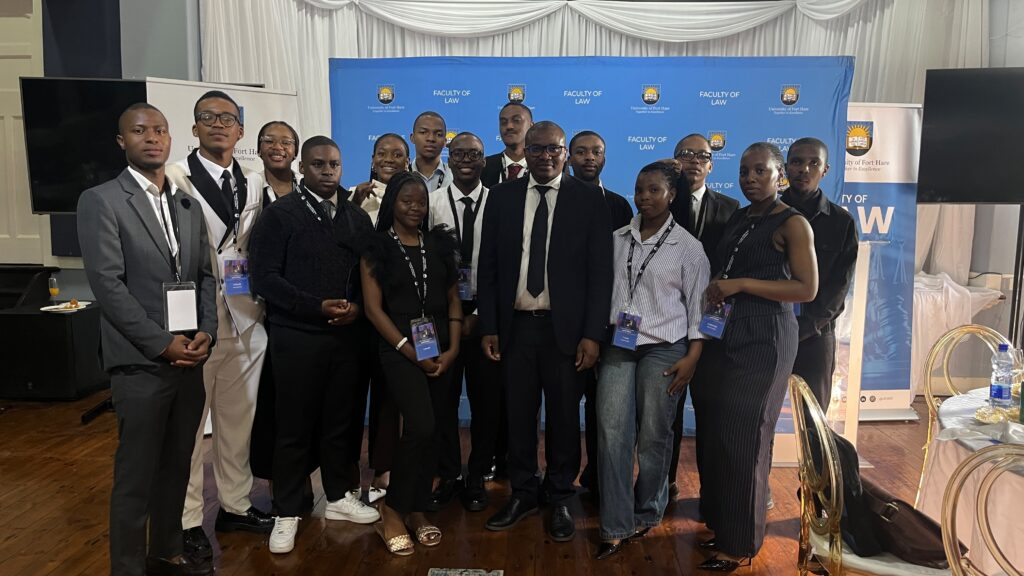
The photograph of Professor Njotini with Justice Madlanga and the students captures that relationship: the jurist representing accumulated legal experience, the Dean representing academic stewardship and the students representing the future. Between them lies one of the central responsibilities of a university — to transmit knowledge without imprisoning the next generation inside the assumptions of the previous one.
The University Behind the Headlines
Fort Hare has faced difficult questions concerning governance, leadership and institutional accountability, and those questions deserve legitimate public scrutiny. But they should not become the only story told about the university.
A university can experience institutional difficulties while its students produce outstanding work. It can require accountability while simultaneously generating scholarship of considerable value. These realities are not contradictory.
For journalism, that complexity matters. Public institutions should neither be romanticised nor reduced to their failures. Fort Hare is a historic institution, a public university and a community of scholars, but it is also a place where young people are being prepared for professional and civic life. Its problems deserve scrutiny, but so do its achievements. Both belong in the public record.
The Constitutional Generation
The students entering the Madlanga Moot will eventually practise law in a society confronting questions that earlier generations could scarcely have imagined. Artificial intelligence is challenging established concepts of evidence, privacy and regulation. Digital platforms are reshaping freedom of expression, while climate change, cybersecurity, continental trade, migration, human rights and customary law are generating increasingly complex legal questions.
The next generation of African lawyers will therefore require more than technical competence. They will need intellectual independence, institutional understanding and the confidence to question power without assuming that every exercise of authority is illegitimate. That is where the Moot can acquire significance far beyond its competition schedule.
The Journalist’s Responsibility
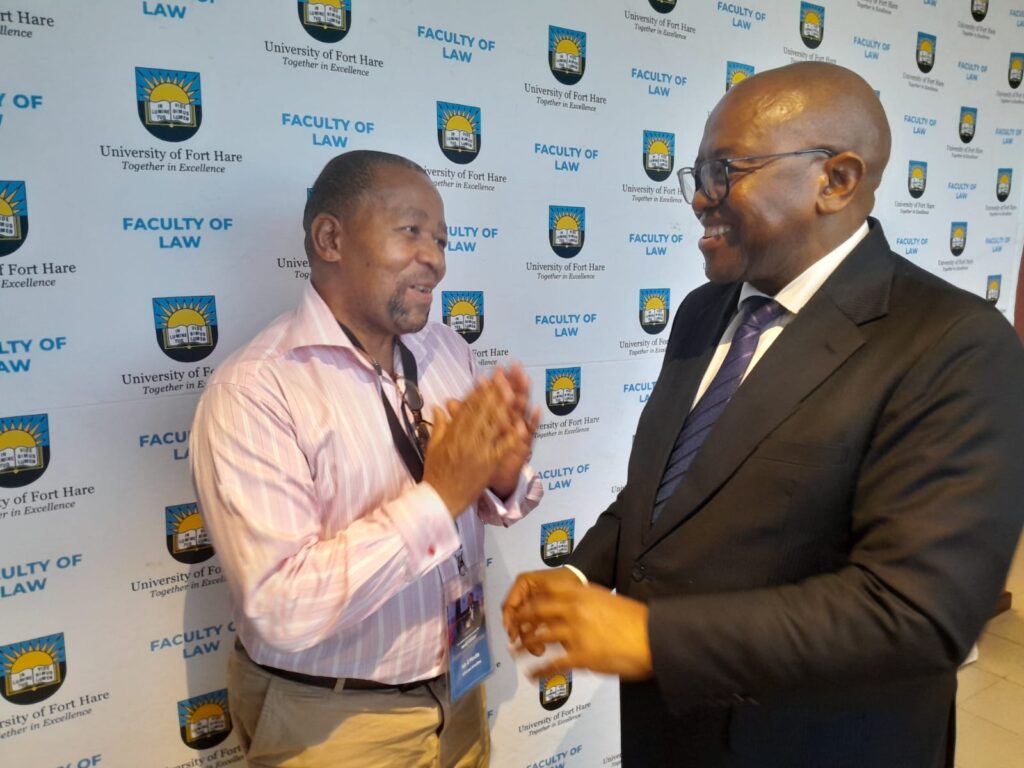
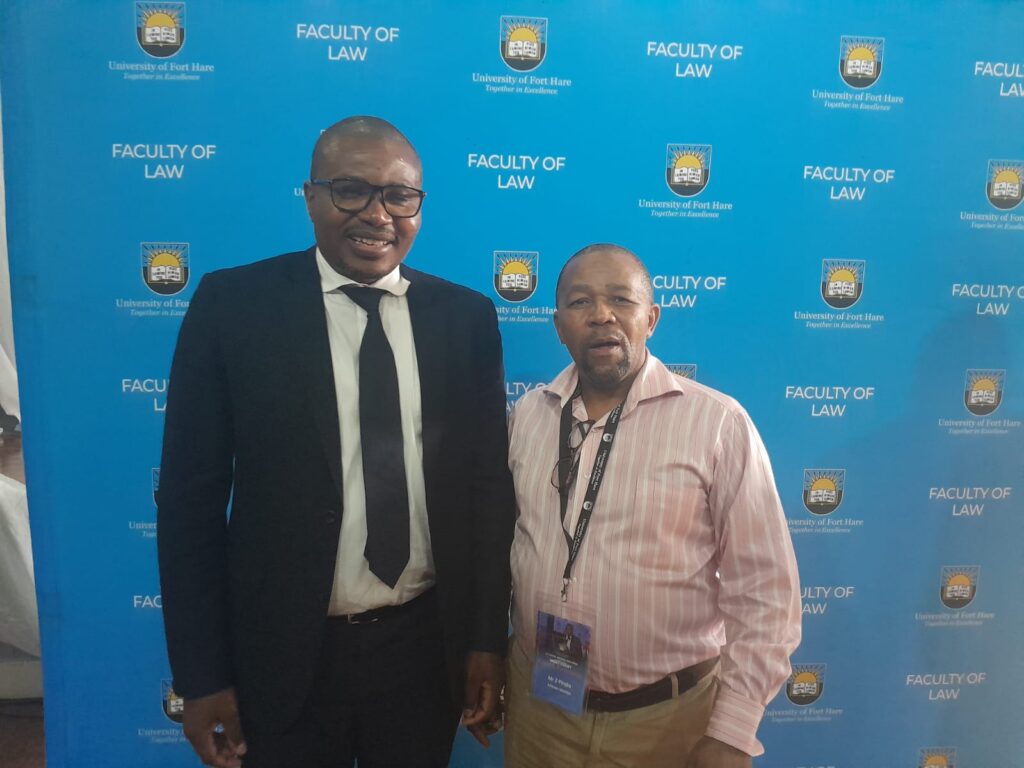
I attended the Fort Hare occasion as a journalist. A photograph of me with Justice Madlanga may appear incidental, but for me it represents something more fundamental: the ability of journalism to engage directly with people who occupy positions of public responsibility.
Access, however, is not influence. It is not patronage, nor is it immunity from scrutiny. It is simply an opportunity to ask better questions. That distinction is central to responsible journalism.
The press must be able to recognise achievement without becoming promotional and investigate institutional failure without becoming destructive. It must inform citizens, examine public authority and give those being scrutinised a fair opportunity to respond.
My own understanding of that responsibility was shaped at Rhodes University, where I studied journalism during a period of profound political transformation in South Africa. I later obtained an MA in Professional and Business Communication from La Salle University in Philadelphia and moved into senior public-sector leadership, including positions within the National Prosecuting Authority and Directorate of Special Operations.
Those experiences placed me on both sides of the institutional divide. Journalism asks institutions questions from the outside, while executive leadership confronts the pressures of making institutions function from within. A mature democracy needs both perspectives.
A Legacy Is Not a Monument
The significance of the Madlanga Moot will ultimately be determined not by the dignity of its launch but by what follows. Will it attract leading African and international law schools? Will judges and practitioners engage with the students? Will the competition generate research, scholarship and lasting institutional relationships? Most importantly, will the young lawyers who emerge from it contribute to the development of African jurisprudence?
These are reasonable questions because an ambitious institution must eventually be judged by its outcomes.
The most meaningful tribute to Justice Mbuyiseli Madlanga will therefore not be that his name appears on a competition. It will be that, years from now, one of the students who stood with him at Fort Hare enters a courtroom, university, Parliament, government or civil society and possesses the intellectual courage to say:
This is what the Constitution requires.
And then defend it.
That is how a jurist’s legacy becomes larger than the jurist himself. It moves from the individual to the institution, from the institution to the student and from the student to society.
That is how history becomes inheritance.
And that is how the students of Fort Hare may begin to write what comes next.
About the Author
Zola Pinda is a Rhodes University journalism graduate with an MA in Professional and Business Communication from La Salle University, Philadelphia. He has held senior public-sector and government communication roles. His writing focuses on governance, geopolitics, the justice system and public accountability.. – @NewsSA_Online
Follow us on our social media platforms below: