BY DR FUMENE GEORGE TSIBANI:
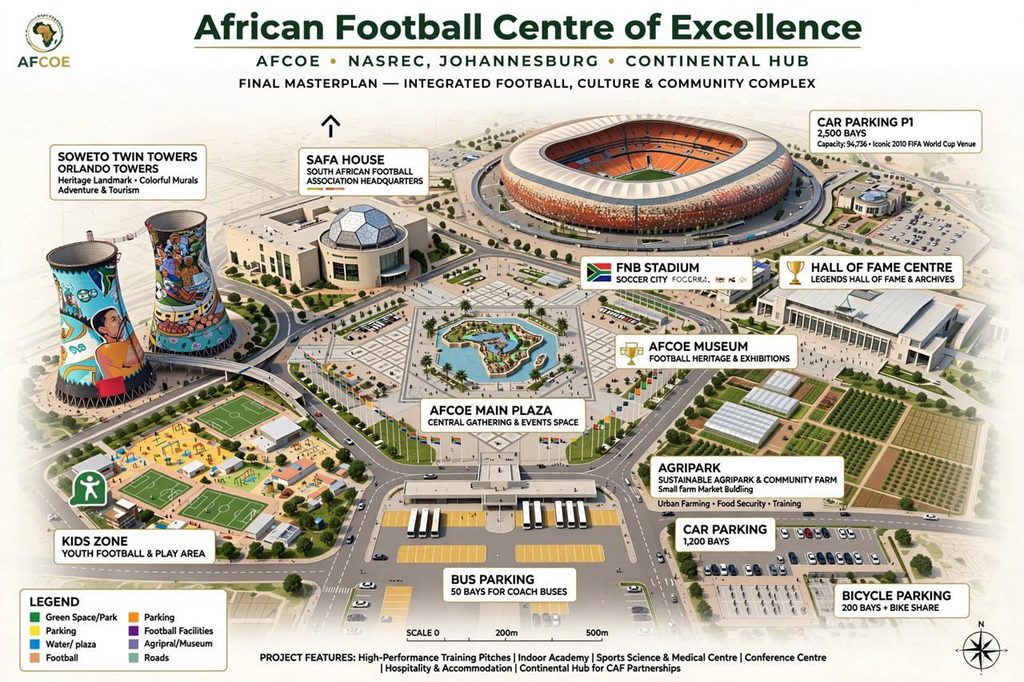
More Than Games
Sport, recreation, arts and culture in South Africa have never been merely games. They are a social compact, a healing archive and a nation-building instrument. They carry the burden of division and the promise of unity. In a country still reconciling its past, sport remains one of the few languages that all South Africans speak fluently.
As we approach Heritage Month in September, it is fitting that we dedicate this month to our sporting heritage across all thirty-two sporting codes recognised in South Africa. This dedication must place at its centre the iconic class of 1995 and 1996, the legends who taught a young democracy how to believe in itself. The year 1995 gave us the Rugby World Cup hosted and won on home soil. The year 1996 gave us the Africa Cup of Nations, hosted and won on home soil. These were foundational acts of social cohesion.
History As Blueprint
To sustain such success, we must be guided by a rich history of football compiled from 1864 to 2025, documented together with the Gauteng Department of Sport, Recreation, Arts and Culture (GDSRAC), community clubs, the South African Football Federation structures, the South African Football Association (SAFA), football legends, schools and universities. This longitudinal record, when viewed alongside Agenda 2063: The Africa We Want, provides clear evidence that South Africa requires a high-performance institutional anchor.
That anchor is best understood through the SPLISS framework. SPLISS stands for Sports Policy factors Leading to International Sporting Success. The model has been adopted and adapted from countries that have dominated the Fédération Internationale de Football Association (FIFA) World Cup, namely Argentina, Brazil, Italy, Spain, Germany, England, France, Norway, Denmark and Sweden. These nations invest systematically in grassroots participation, talent identification, coach education, competition pathways, scientific research and infrastructure. Their success is policy-driven. South Africa must localise this model for African conditions.
Why AFCOE?
From the history of football in South Africa from 1864 to 2025, it became clear from consultations with football players, icons, managers and legends that the missing link is a dedicated African Football Centre of Excellence. The African Football Centre of Excellence (AFCOE) is needed to leverage football Gross Domestic Product (GDP) in a manner similar to countries such as Spain, Italy and Brazil. In those countries, football is a major contributor to tourism, employment, broadcasting, manufacturing and community development. Spain, Italy and Brazil have converted football heritage into economic value through academies, museums and training centres. South Africa has talent and hosting experience but lacks a single integrated hub.
From 2026 To 2030
The central motivation for AFCOE is performance. Africa must perform far better in 2030 than in 2026. The 2026 Fédération Internationale de Football Association (FIFA) World Cup will be a benchmark, but 2030 is where Africa must move from participation to contention. This will not happen through hope alone. It requires an institution. As the wisdom of our elders teaches, talent without structure is wasted, and history without preservation is forgotten. If we do not build the house to keep our legends, we will forever rent space in other people’s houses.
NASREC As Heart of Africa
Therefore, we need to build AFCOE in NASREC, the National Recreation Centre precinct, in the City of Johannesburg, within Gauteng Province, the economic hub of Africa. NASREC is the heart of football for Africa. It hosted the 2010 Fédération Internationale de Football Association (FIFA) World Cup final. It must now host the future. From this central hub, AFCOE will provide satellite support programmes in all Confederation of African Football (CAF) countries. This hub and spoke model ensures excellence is centralised for quality but decentralised for access. Each satellite centre will be linked digitally and technically to NASREC, creating a continental high-performance network.
Technology Driven Excellence
Technically, AFCOE must be driven by Fourth Industrial Revolution (4IR) technologies. It must be powered by Artificial Intelligence (AI) for talent analytics, performance analysis, injury prevention and scouting. It must be secured through Closed Circuit Television (CCTV) camera systems for safety and technical analysis. It must incorporate robotics for repetitive technical training and rehabilitation. It must integrate humanoids for interactive coaching education and fan engagement. It must use Big Data and Data Analytics (BDZA) for player tracking and load management. It must be fully connected through Fifth Generation (5G), Sixth Generation (6G) and Seventh Generation (7G) mobile networks to enable real-time data transfer and virtual reality learning. It must be governed by Fifty One Remote Control Internet Protocol Zone Control (51RC IPZC) control technology for intelligent facility management and energy efficiency.
Investment Case and Wisdom
The investment case is clear. Football is Gross Domestic Product (GDP). A single academy graduate who succeeds internationally generates return through transfer fees, taxation and brand value. Technology reduces cost. Robotics and humanoids allow twenty-four-hour training cycles and extend careers. Satellite connectivity multiplies impact. A curriculum developed in Johannesburg can be delivered simultaneously in Dakar, Cairo and Kigali through Fifth Generation (5G) and Sixth Generation (6G) enabled classrooms, with Artificial Intelligence (AI) translating into local languages.
Heritage becomes capital. AFCOE will store the knowledge, memorabilia and methodologies of African icons and legends in both central and satellite centres. A young girl in a Confederation of African Football (CAF) country can learn finishing from archived sessions of Samuel Eto’o, while a young coach studies pressing principles from the 1996 Bafana Bafana legends preserved through Artificial Intelligence (AI) and humanoid demonstration. This is how we convert memory into methodology. The wisdom of African football teaches that a child who is not embraced by the village will burn it down to feel its warmth. AFCOE is that embrace.
Beyond Ceremony
Honouring the class of 1995 and 1996 during September Heritage Month must go beyond ceremony. It must become infrastructure. Building the African Football Centre of Excellence (AFCOE) in NASREC, in the City of Johannesburg, Gauteng, as the economic hub of Africa, with satellite centres across all Confederation of African Football (CAF) countries, driven by Artificial Intelligence (AI), Closed Circuit Television (CCTV) camera, robotics, humanoids, Big Data and Data Analytics (BDZA), Fifth Generation (5G), Sixth Generation (6G), Seventh Generation (7G) and Fifty One Remote Control Internet Protocol Zone Control (51RC IPZC) control technology, ensures that Africa will perform far better in 2030 than in *2026.
Dr Fumene George Tsibani, Water Governance and Heritage Expert, Faculty of Engineering and the Built Environment, University of Johannesburg. He is writing in his personal capacity.
Follow us on our social media platforms below: