By Zola Pinda:
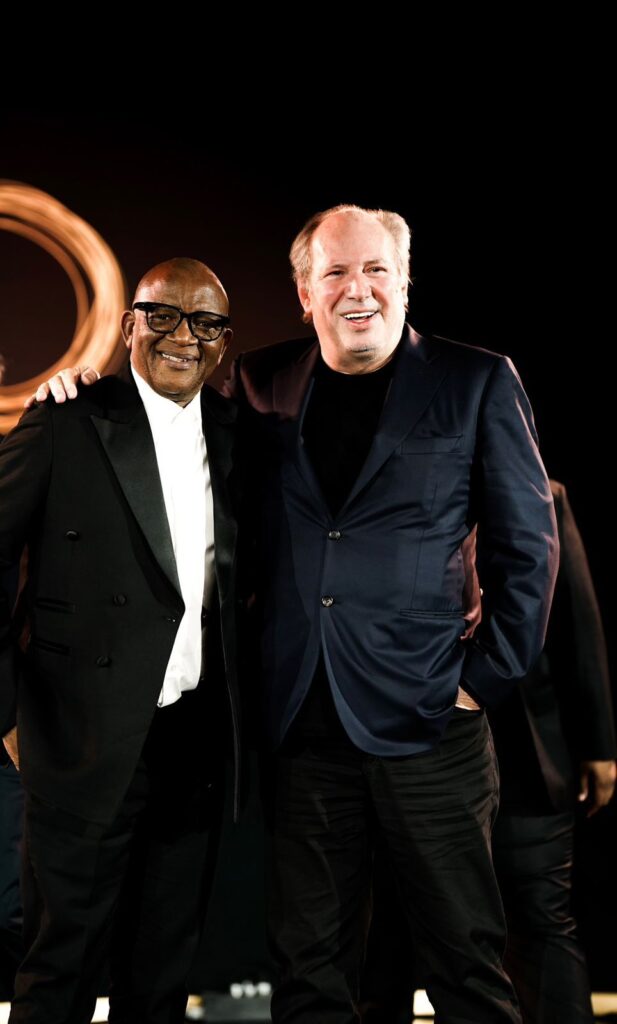
There are moments in a nation’s life when it must pause and ask itself a difficult question: Do we truly recognise our own?
Few South African artists have ascended to the global heights reached by Lebo M. From the streets of Soweto to the grand stages of the world, his journey is not merely one of personal triumph, but of cultural elevation — a sustained, deliberate projection of South African identity onto the global stage. For over three decades, he has not only performed; he has defined a sound that carries the soul of a nation.
Across Europe and beyond, concert halls continue to fill. Audiences rise. The music resonates. This is not nostalgia; it is relevance. It is continuity. It is mastery. And yet, in a striking contradiction, the depth of this achievement often struggles to find proportionate reflection within the very country that produced it.
This is the paradox we must confront.
At home, the narrative is too often reduced — fragmented into fleeting headlines, detached from context, stripped of its historical and cultural weight. The complexity of a career built over decades is compressed into moments that neither inform nor honour the full measure of the contribution. In doing so, we are not merely underreporting a figure; we are diminishing our own national archive.
This is not an argument for uncritical praise. It is an argument for balance. For depth. For perspective.
Because Lebo M is more than a performer. He is, in every sense, a cultural conduit. Through his work, South African artists have found pathways onto international platforms. Young talent — often from the most modest beginnings — have stood before global audiences, their lives irrevocably changed. That is not incidental. That is structural impact.
And yet, how often are these stories told in full?
The role of the media, particularly in a society as layered and historically complex as ours, is not simply to report what is immediate. It is to interpret, to contextualise, and ultimately to educate. It is to ensure that a nation understands not only what is happening, but why it matters. When that responsibility is narrowed to the pursuit of immediacy alone, something vital is lost.
It is here that a broader shift becomes evident. The traditional newsroom, once the undisputed gatekeeper of public narrative, now operates alongside a rapidly evolving digital ecosystem. Online platforms have introduced a new dynamic — one where stories are no longer confined to editorial discretion within closed rooms, but are instead subject to public engagement, scrutiny, and amplification in real time.
This is not a threat to journalism. It is an expansion of it.
Platforms such as https://www.newssa.co.za
https//www.gsmn.co.za
Global South Media Network represent more than an alternative; they represent a necessary complement. A space where narratives can be explored with the depth they deserve, where continuity is preserved, and where the public can access a complete body of work rather than isolated fragments. In the case of Lebo M, this is particularly significant. His story cannot be told in a single article. It requires a repository — a living archive — that reflects the scale of his contribution.
I write this from a position shaped not by impulse, but by training and discipline under the late Professor Gavin Stewart, former Head of the Department of Journalism at Rhodes University and later Editor-in-Chief of the Daily Dispatch, and influenced by the incisive analytical tradition of Don Pinnock. I was immersed in a culture of journalism that understood its role as both witness and interpreter. This was a time when the stakes of storytelling were immeasurably high, when the responsibility to society was not theoretical, but immediate and consequential. That foundation does not permit silence where there is imbalance.
Let us be clear: this is not a lament. Nor is it an appeal for favour.
It is a call for alignment — between achievement and acknowledgement, between contribution and coverage. It is an insistence that South Africa must take itself seriously enough to document its own excellence with rigour and respect.
Because if we fail to do so, the loss is not Lebo M’s. His place on the global stage is secure. The loss is ours. It is a quiet erosion of our collective memory, a weakening of the narrative threads that bind a nation to its own story.
The question, then, is not whether Lebo M deserves recognition. That has long been answered — on stages far beyond our borders.
The real question is whether we, as a country, are prepared to recognise the full measure of what we have already given to the world.
Zola Pinda is a Rhodes University-trained journalist with a Master’s degree in Professional and Business Communication from LaSalle University in Philadelphia. He has held senior communications roles in South Africa’s law enforcement and prosecutorial institutions, including Director of Communications for the “Scorpions” Directorate of Special Operations (DSO) and the National Prosecuting Authority (NPA), and later served as an Assistant Director-General in national government. Contact Cell: 068 596 7093 – @NewsSA_Online
Follow us on our social media platforms below: