Mayor says Ekurhuleni will pursue accountability through law and due process — but the removal of a journalist during the Q&A has raised fresh questions about how scrutiny is handled
BY SINDISO NTHLABATHI:
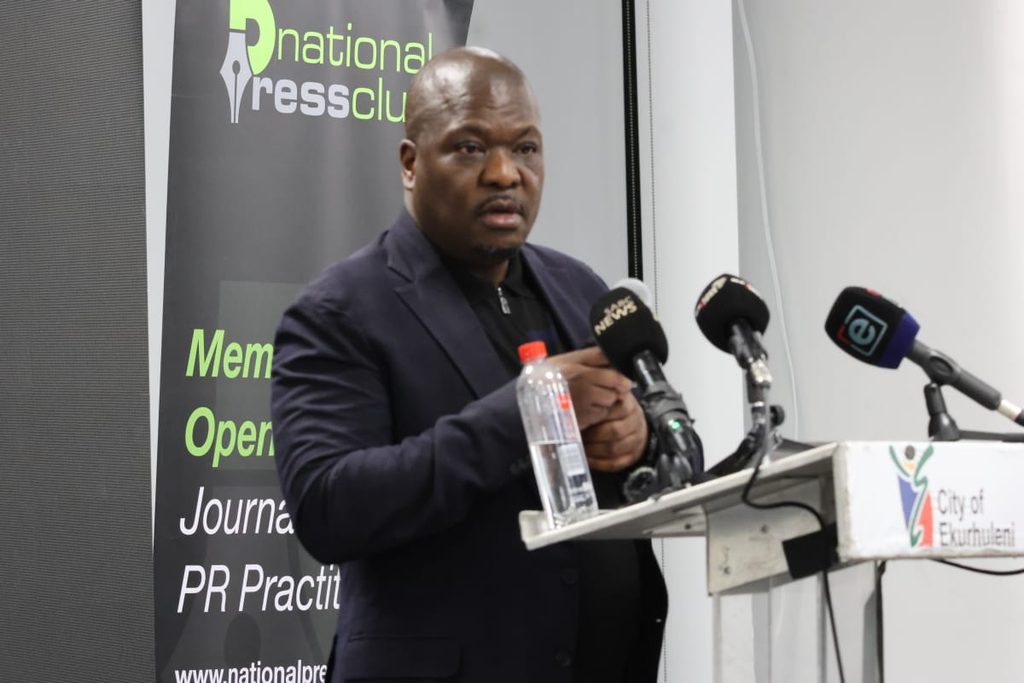
City of Ekurhuleni Executive Mayor Nkosindiphile Xhakaza arrived at the National Press Club with a message built around one principle: ‘allegations must be tested through proper processes before they become findings’. By the end of the event, that principle had acquired a second, unexpected test.
Xhakaza used his address to defend the City’s approach to the fallout from the Madlanga Commission and allegations surrounding the Ekurhuleni Metropolitan Police Department (EMPD). He argued that testimony before a commission, verified facts, and formal findings should not be treated as interchangeable.
His position was that political leadership should not dictate investigative outcomes and that individuals should not be condemned on the basis of untested allegations.
That position is central to the City’s stated approach to consequence management.
Xhakaza said three senior officials — the heads of Human Resources, Legal and Risk, and the Chief Information Office — were dismissed in July 2026. He also announced the termination of EMPD Deputy Chief Julius Mkhwanazi following disciplinary proceedings.
The mayor acknowledged that lengthy suspensions had frustrated residents but argued that removing individual officials would not, on its own, resolve the institutional weaknesses that allowed problems to develop.
QUESTIONS ABOUT THE PREVIOUS ADMINISTRATION
One of the more politically sensitive sections of the address concerned the history of the EMPD and what Xhakaza described as the previous administration’s failures.
The mayor raised questions involving former Executive Mayor Tania Campbell and convicted criminal Vusimuzi “Cat” Matlala.
According to Xhakaza, allegations had emerged concerning an alleged meeting between Campbell and Matlala, as well as private security services allegedly provided by Matlala that were not declared.
Xhakaza also questioned what the then MMC for Community Safety knew about alleged criminal infiltration of the municipal police service.
These remain allegations and questions requiring verification and due process. They should not be treated as established findings unless supported by formal investigative or judicial outcomes.
The distinction is important because it mirrors the very principle advanced by Xhakaza in his address: testimony and allegations must be distinguished from verified facts and formal findings.
REBUILDING THE EMPD
The mayor announced several measures aimed at stabilising the EMPD.
Former chief Isaac Mapiyeye has been brought back for a six-month period as the City works towards longer-term leadership arrangements.
Xhakaza also said EMPD personnel were being subjected to vetting with the involvement of the State Security Agency.
The measures come as the municipal police department remains under intense scrutiny following evidence and allegations surrounding policing, procurement and alleged criminal influence.
The central question is whether personnel changes and disciplinary action will translate into lasting institutional reform — or whether the City will continue responding to individual cases without fully addressing the systems that allowed the problems to develop.
THE R2 BILLION REVENUE PROBLEM
Xhakaza also addressed Ekurhuleni’s electricity revenue problems, citing a roughly R2 billion historical shortfall linked to billing and meter-reading failures.
The mayor said meter accuracy had improved from 84% to 97% and that approximately R365 million had been recovered.
For residents, however, the bigger questions concern how the revenue losses occurred, who was responsible for the failures, what corrective measures have been implemented and whether the recovery of revenue will translate into improved municipal services.
The figures therefore form part of a wider accountability question facing the administration: whether improvements in systems can be sustained and whether those responsible for previous failures will face appropriate consequences.
THEN CAME THE Q&A
It was against this backdrop that the event’s most immediate controversy unfolded.
During the question-and-answer session, journalist Vladimir Modiba stood to ask a question.
According to the account available to this publication, Mayor Xhakaza initially indicated that he was prepared to take the question.
The Programme Director then intervened and instructed that Modiba be escorted from the venue.
Members of the EMPD detail accompanying the mayor subsequently approached Modiba and removed him from the hall.
The incident was captured on video by a journalist who was present at the event.
The circumstances surrounding the removal are now at the centre of a separate accountability question.
What was the question Modiba intended to put to the mayor?
Why was he removed after the mayor had apparently indicated that he was prepared to take the question?
And who made the final decision to have him escorted from the venue?
Those questions remain unanswered.
THE PRESS CLUB’S POSITION
Following the incident, the National Press Club provided its position on what had happened.
The Press Club said it was not aware of Modiba as a journalist and that official journalism bodies had not indicated him as a member. It also stated that he was not a member of the National Press Club.
The Club further said Modiba had disrespected the protocols established for the event. According to the Club, Modiba had also been offered an opportunity to have a one-on-one engagement with the mayor after the programme because the event was organised by the National Press Club rather than the City of Ekurhuleni.
The Press Club’s position raises a separate question about the distinction between accreditation, membership and participation at a public media event.
Being a member of a professional organisation is not necessarily the same thing as being entitled to attend or ask questions at every media briefing. Equally, the fact that someone is not a member of a particular organisation does not, by itself, establish whether their removal was justified.
The circumstances surrounding the incident therefore require consideration of the event’s protocols and what occurred immediately before Modiba was removed.
MODIBA’S RESPONSE
Questions were sent to Modiba seeking his account of the incident.
He was asked what question he intended to put to Xhakaza, what his current journalistic affiliation was, how he responded to the Press Club’s position regarding accreditation and membership, and why he did not accept the proposed one-on-one engagement.
He was also asked what outcome he was seeking following his removal and whether he intended to take any formal action.
Modiba did not provide direct responses to those questions before publication.
He subsequently addressed the matter on social media, rejecting the Press Club’s position and asserting that his work had appeared on international platforms.
He also accused
the organisation of protecting politicians rather than accountability.
Those statements represent Modiba’s position and have not been independently verified.
WHAT REMAINS UNANSWERED
The incident leaves several questions that cannot be resolved simply by competing accounts.
First: What precisely did Modiba intend to ask the mayor?
Second: What specific event protocol did he allegedly breach?
Third: Who instructed the EMPD members to remove him?
Fourth: Why was he removed after the mayor had apparently indicated that he would take the question?
Fifth: Was the proposed one-on-one engagement intended as an alternative to the public question, and was it offered before or after the decision to remove him?
Sixth: Will the National Press Club provide a formal account of the incident?
Seventh: Will the Mayor’s Office explain the role, if any, played by the mayor in the decision to remove Modiba?
These questions are important because the incident occurred during an event centred on governance, accountability and public scrutiny.
A SECOND ACCOUNTABILITY TEST
The significance of the incident extends beyond one journalist and one event.
Xhakaza’s central argument at the Press Club was that accountability must be grounded in evidence, due process and institutional mechanisms rather than media headlines.
That principle should be capable of being applied consistently.
If Modiba breached established event protocols, the public deserves to know what those protocols were and precisely how they were breached.
If his removal was unrelated to the substance of his intended question, that should also be established.
If the mayor had agreed to take the question before the Programme Director intervened, an explanation is warranted as to why the mayor’s apparent decision was overridden.
And if force was used to remove a journalist from a media event, the circumstances surrounding that intervention deserve transparent examination.
At the time of publication, the National Press Club had not issued a detailed public statement addressing the incident.
The Mayor’s Office had also not publicly explained why Modiba was removed after Xhakaza had apparently indicated that he would take the question.
The unanswered questions therefore remain.
The mayor’s message at the Press Club was clear: Ekurhuleni’s problems should be confronted through law, evidence and due process — not headlines.
The events surrounding the Q&A have now created an opportunity to test that principle from another direction: how does an administration that demands accountability respond when the scrutiny is directed at those exercising authority?
That answer may ultimately be as important as the speech itself. – @NewsSA_Online
Follow us on our social media platforms below: